Nigeria's commercial capital Lagos does not ease you in. You step off the plane into heat that has weight to it, join a highway that moves on its own logic, and within twenty minutes you realize that this city operates at a frequency you have never encountered before. Twenty-two million people, an economy larger than most African countries, and an energy that makes even seasoned expats recalibrate. The generator hum is the city's heartbeat. The traffic on the Lekki-Epe Expressway will test your patience and your marriage. And then someone will invite you to a rooftop in Victoria Island, and you will understand why people fall for this place and never quite leave.
For international families, Lagos presents a paradox: a city with enormous commercial gravity — oil and gas, fintech, telecoms, Nollywood — but an international school market that is still catching up to the demand. With 29 international schools across 14 curricula, this is not Dubai or Singapore with hundreds of options and published fee comparisons. Lagos is a market where personal recommendations carry more weight than brochures, where school visits are non-negotiable, and where the right choice depends as much on where you live and how you handle the commute as on the curriculum itself.
This guide draws on real data from Scholae, practical knowledge of the city, and the kind of honest assessment that marketing material will never give you.
The curriculum landscape: overwhelmingly British, with important exceptions
British curriculum — the clear dominant force
Of Lagos' 29 international schools, roughly 22 follow the British system in some form — the English National Curriculum, IGCSE, A-Levels, or combinations thereof. This is not surprising. Nigeria was a British colony until 1960, and the educational infrastructure was built on British foundations. The University of Cambridge's IGCSE examinations remain the gold standard for secondary-age students, and A-Levels are universally recognized for university entry across the UK, Europe, and increasingly North America.
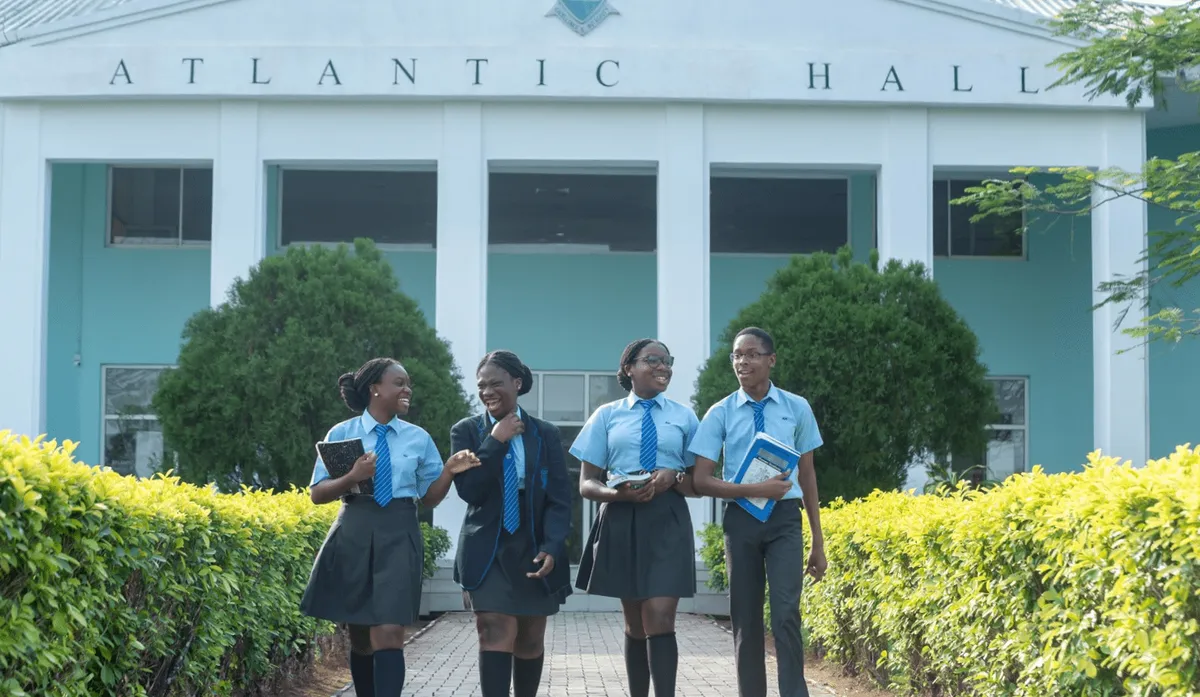
The quality range within "British curriculum" is wide. At the top end, you have schools like Grange School, founded the same year as Nigerian independence in 1964, running a proper IGCSE programme with specialist subject teachers. Atlantic Hall School, also established in 1989, offers both IGCSE and WASSCE (the West African Senior School Certificate Examination), giving students dual qualification pathways. The RiverBank School, with 1,280 students and an IGCSE track layered onto a Montessori early years foundation, represents the newer generation of Lagos schools that have grown rapidly since their founding in 2009.
Then there is Rugby School Nigeria, which opened in 2025 in Eko Atlantic City — the first African outpost of the storied 457-year-old English public school. This is a significant arrival. Rugby School is not a franchise operation using a borrowed name; it carries the institutional weight and pedagogical philosophy of the original. British curriculum through to A-Levels, located in what is essentially a new city being built on reclaimed land off Victoria Island. Whether Eko Atlantic fulfils its ambitions or remains a construction site with aspirations is still an open question, but Rugby's commitment to the location signals real confidence in Lagos' trajectory.
At the other end, some schools attach "British" or "international" to their name with less substance behind it. The distinguishing markers to look for: BSO (British Schools Overseas) accreditation, Cambridge International affiliation for IGCSE delivery, and the school's actual exam results. If a school cannot show you its IGCSE pass rates, treat the "British curriculum" label with caution.
International Baccalaureate and American curriculum
The IB and American pathways are represented primarily by one school, and it is the one that matters most: American International School of Lagos (AISL). Founded in 1964 with 472 students, AISL is accredited by the Council of International Schools, the Middle States Association, and the IBO. It offers the American curriculum with the IB MYP and IB Diploma Programme, making it the only school in Lagos where you can access the full IB Diploma pathway. Class sizes average 18. The academic year runs August to June on a semester system.
AISL is Lagos' equivalent of the embassy school — the default choice for diplomatic families, multinational executives, and anyone whose employer is covering tuition. If you are coming from another American-system or IB school elsewhere in the world, AISL provides the smoothest transition. If your next posting could be anywhere and you need maximum portability of qualifications, the IB Diploma here is your best option in Lagos.
Oxbridge Tutorial College, founded in 1993 in Ikeja GRA, offers an unusual British-American dual track with both A-Levels and the American pathway. With only 150 students and average class sizes of 15, it operates as a specialist sixth-form college — Nigeria's first, by its own account. This is a niche choice for older students who need focused university preparation.
French curriculum
Lycee Francais Louis Pasteur is the sole French-system school, and it is excellent. Founded in 1958 — predating Nigerian independence — it sits on Victoria Island with 580 students and class sizes of 17. Approved by the French Ministry of Education as part of the AEFE network of 580 French schools worldwide, it delivered a 100% pass rate on the French Baccalaureate in 2024, exceeding the AEFE global benchmark of 96.7%. Languages of instruction include French, English, Arabic, Spanish, and German. If your family is Francophone or you want your children educated within the French system, this is the only option in Lagos, and it is a genuinely strong one.
Nigerian curriculum blends
Several schools integrate the Nigerian curriculum alongside British pathways. Meadow Hall School, with 1,400 students on the Lekki-Epe Expressway, runs an integrated British-Nigerian programme. Canterbury International Schools in the Lekki-Ajah corridor combines British, Nigerian, and Christian curricula. These dual-track schools appeal to families with one Nigerian parent who may want their children to sit WASSCE alongside IGCSE, keeping the Nigerian university pathway open.
What it costs: the fee reality
Lagos is the most expensive city in West Africa, and school fees reflect it. However, here is the honest complication: most Lagos international schools do not publish their fee schedules publicly. Fee transparency is notably worse here than in Dubai, Singapore, or Nairobi. You will need to contact schools directly, and you should expect the conversation to happen in person or over the phone rather than via a tidy PDF on a website.
What we can tell you, based on available data and market knowledge (using approximately NGN 1,550 = $1 USD as of early 2026):
Entry-level international (NGN 3M-6M / ~$2,000-$4,000 per year): Smaller schools with Nigerian-British hybrid curricula, less extensive facilities, and a predominantly local student body. These schools may use the "international" label but serve primarily Nigerian families seeking a British-style education. You are getting English-medium instruction and some level of IGCSE preparation, but do not expect the full international school experience.
Mid-range (NGN 6M-15M / ~$4,000-$10,000 per year): This is where most established Lagos international schools sit. Schools like Avi-Cenna International School, with 600 students and an NGN 50,000 application fee, and Grange School fall in this bracket. You are getting proper IGCSE delivery, reasonable facilities, and class sizes of 15-20 students. This tier represents solid value for Lagos.
Premium (NGN 15M-35M+ / ~$10,000-$23,000+ per year): American International School of Lagos, Rugby School Nigeria, and Lycee Francais Louis Pasteur sit at the top of the market. AISL, with its triple accreditation (CIS, MSA, IBO) and full IB Diploma programme, commands fees in line with international schools in other major African cities. Rugby School Nigeria, as a brand-new campus of a premium British institution, prices accordingly. At this level, you are paying for internationally accredited qualifications, experienced expatriate teachers, modern facilities, and a genuinely diverse student body.
Boarding premium: Atlantic Hall School offers full boarding — unusual for Lagos — and Avi-Cenna International School provides day and boarding options. Boarding adds a significant premium, but for families living on the mainland who want a school on the island (or vice versa), it eliminates the Lagos commute problem entirely.
Hidden costs: Generator fuel surcharges (many schools pass this cost through), transport (school buses are essential and cost NGN 500,000-1.5M/year depending on distance), uniforms, textbooks, extracurricular activities, and exam registration fees for IGCSE and A-Levels. Budget 20-30% above published tuition for a realistic annual total. The generator surcharge is a Lagos-specific cost that catches newcomers off guard — electricity supply is unreliable, and schools run diesel generators for most of the school day.
Schools worth knowing about
Out of Lagos' 29 international schools, here are ten that merit serious consideration — spanning the full range from flagship institutions to solid mid-tier options and a few specialists.
American International School of Lagos (AISL)
AISL is the international school in Lagos — the one that diplomats, oil executives, and UN agency staff default to. Founded in 1964 on Victoria Island, it is accredited by the Council of International Schools, the Middle States Association, and the IBO. With 472 students, an average class size of 18, and the only IB Diploma programme in the city, it occupies a category of one. The American curriculum base with IB overlay means students graduate with qualifications that work anywhere on earth. The trade-off is exclusivity and cost — this is not a school that serves a broad cross-section of Lagos society. It serves the international community, deliberately and unapologetically.
Rugby School Nigeria
Rugby School Nigeria is the newest and perhaps most ambitious school in Lagos. Opened in 2025 in Eko Atlantic City, it brings the name, ethos, and pedagogical approach of Rugby School (founded 1567, birthplace of the sport that bears its name) to West Africa. British curriculum through A-Levels, with entrance via CATs testing, PASS assessment, and a principal interview. The Eko Atlantic location is either visionary or premature depending on your perspective — the development is impressive but still emerging. For families who want a heritage British boarding-school experience without sending their children to England, Rugby School Nigeria is the closest thing Lagos offers.
Lycee Francais Louis Pasteur
Lycee Francais Louis Pasteur is the elder statesman of Lagos' international school scene, founded in 1958 and older than independent Nigeria itself. With 580 students, class sizes of 17, and a 100% French Baccalaureate pass rate, it delivers French-system education at a level that would be competitive anywhere in the AEFE network. The multilingual environment — French, English, Arabic, Spanish, German — produces graduates who are genuinely trilingual. Located on Victoria Island. This is not just the best French school in Lagos; it is one of the best French schools in Africa.
Grange School
Grange School has been in Lagos since 1964 and runs a straightforward British IGCSE programme with specialist subject teachers across 15 subjects. It covers ages 3-18, making it a one-school solution for families who do not want to manage transitions between preparatory and secondary institutions. Grange does not try to be everything — no IB, no American track, no hybrid curriculum. It does British education properly, and that focus is its strength. A solid, no-drama choice for families who know they want the IGCSE-A-Level pathway.
Atlantic Hall School
Atlantic Hall School is distinctive for two reasons: it is one of the very few Lagos international schools offering full boarding, and it runs a dual IGCSE-WASSCE track that gives students both international and Nigerian qualifications simultaneously. Founded in 1989 in Epe (on the eastern edge of Lagos State), the boarding option makes it accessible to families across the entire Lagos metropolitan area regardless of where they live. The school also offers SAT preparation and OSSD pathways for students targeting Canadian universities. If boarding is what you need, Atlantic Hall is your primary option.
The RiverBank School
The RiverBank School is the largest school on this list at 1,280 students, located on Oniru Estate, Victoria Island. Founded in 2009, it layers a Montessori early years programme onto a British IGCSE secondary track with a Christian ethos. Rolling admissions with an entrance exam and an NGN 20,000 application fee. The admissions documentation requirements are thorough — birth certificate, immunisation records, current school report, medical report, and educational psychologist evaluation if applicable. The school has grown rapidly, which reflects genuine demand but also means the institution is still maturing. Worth visiting to gauge whether the growth has been managed well.
Meadow Hall School
Meadow Hall School is the big-campus option in the Lekki corridor, with 1,400 students and an integrated British-Nigerian curriculum. Located on the Lekki-Epe Expressway in Alma Beach Estate, it serves the rapidly growing Lekki-Ajah residential areas where many younger expat families are settling. The dual curriculum means students can pursue IGCSE while remaining eligible for Nigerian university entry — a pragmatic choice for families with one Nigerian parent or those who may stay long-term.
Banana Island International School
Banana Island International School is small, exclusive, and BSO accredited — one of only a handful of Lagos schools that can claim UK government inspection. With just 100 students and class sizes of 15, it serves children from 15 months to 13 years on Banana Island, Lagos' most affluent residential enclave. The language offering is unusual and impressive: English, Mandarin, French, and Cantonese. BSO accreditation means that if your next move is to a British-system school elsewhere in the world, the transition will be smooth. The limitation is obvious — it is a primary school only, so you will need a secondary school plan.
The Netherlands International School Lagos (NISL)
The Netherlands International School Lagos is a charming anomaly — a small, non-profit primary school on Walter Carrington Crescent, Victoria Island, founded in 1967 with BSO accreditation and average class sizes of just 12. It offers a British-Dutch dual curriculum, with Dutch language instruction for Dutch nationals' children. The school is genuinely international, welcoming all nationalities and maintaining a warm, community-focused ethos. Like Banana Island, it covers only early years and primary, so secondary planning is essential. But for younger children, the intimate scale and BSO quality assurance make NISL worth serious consideration.
St Saviour's School
St Saviour's School in Ikoyi is another primary-only option with approximately 340 students and a British curriculum focus. Ikoyi is one of Lagos' most established and pleasant residential areas, and St Saviour's has long been a fixture of the local expat community. A day school only, it covers Foundation through Year 6. If you are living in the Ikoyi area and want a neighbourhood school where the morning run does not involve crossing a bridge or sitting in an hour of traffic, St Saviour's delivers that.
Neighbourhoods: where to live and why it matters more than usual
In most cities, the school-to-home commute is a consideration. In Lagos, it is the consideration. The city is built across islands and a mainland connected by bridges that bottleneck catastrophically during rush hours. A school that is eight kilometres away can take 15 minutes or two hours depending on the day, the bridge, and whether it rained. Your neighbourhood choice will define your daily experience more than almost any other decision you make.
Victoria Island (VI)
The commercial and diplomatic heart of Lagos' island geography. AISL, Lycee Francais Louis Pasteur, Bridge House College, and Rugby School Nigeria (Eko Atlantic) are all here or adjacent. VI is where most international businesses have their offices, where the best restaurants and hotels are concentrated, and where the expat social scene is most active. Rent is the highest in Lagos — expect $3,000-$6,000/month for a proper family apartment. The advantage is proximity to everything; the disadvantage is that VI floods during heavy rains and the generators run constantly. If your school and your office are both on VI, your quality of life will be meaningfully better than if you are commuting across the bridge daily.
Ikoyi
Adjacent to VI but more residential, quieter, and tree-lined. St Saviour's School, The Foreshore School, and Banana Island International School are here. Ikoyi has the best security profile in Lagos, beautiful waterfront areas, and a sense of established calm that VI lacks. Banana Island itself is a gated enclave within Ikoyi — effectively a fortified residential island within an island. Rent in Ikoyi proper runs $2,500-$5,000/month; Banana Island is considerably higher. For families with young children, Ikoyi offers the safest, most walkable environment in Lagos.
Lekki (Phase 1, Chevron, VGC, Ajah)
The fast-growing residential corridor east of VI, connected by the Lekki-Epe Expressway. Meadow Hall School, Canterbury International Schools, and The RiverBank School serve this area. Lekki has newer housing stock, more space for the money ($1,500-$3,500/month), and a suburban feel that appeals to families with multiple children. The trade-off is infrastructure — the Lekki Toll Gate and expressway congestion can make the commute to VI brutal. If your school is in Lekki and you live in Lekki, life is manageable. If you are commuting from Lekki to a school on VI, budget at least 60-90 minutes each way.
Ikeja GRA and Mainland
Ikeja Government Reserved Area is where Avi-Cenna International School, Oxbridge Tutorial College, and Temple School are located. The mainland is where most Lagosians actually live, and Ikeja GRA is its most upscale residential area — close to the domestic airport, with good housing stock and significantly lower rents than the island ($1,000-$2,500/month). The Third Mainland Bridge connects Ikeja to VI and Ikoyi, but the bridge commute is one of Lagos' most infamous bottlenecks. If your school is on the mainland, live on the mainland. Crossing the bridge twice a day for school is a life decision you will regret.
Admissions: what to expect and how to prepare
Timing and the academic calendar
Most Lagos international schools follow the British academic year — September to July, divided into three terms. AISL runs on an American August-to-June semester calendar. Applications for popular schools typically open in the preceding January-March, with entrance assessments conducted between February and June. The most in-demand schools — AISL, Rugby School Nigeria, Grange School — will have limited availability for popular year groups by April.
Start your school search the moment a Lagos posting is confirmed. Four to six months of lead time is ideal. Two months is tight but workable for schools with rolling admissions.
Entrance assessments
Nearly every school requires some form of entry assessment. AISL conducts formal evaluations. Rugby School Nigeria uses CATs (cognitive ability testing) and PASS (attitudinal/wellbeing assessment) plus a principal interview. Avi-Cenna and The RiverBank School require entrance examinations. For younger children, assessments are typically observational and developmental. For secondary-age applicants, expect tests in English and mathematics at minimum.
Documents to prepare
Have these ready before you begin contacting schools:
- Passport copies (child and both parents)
- Birth certificate (original and copy)
- Immunisation records (Nigeria requires specific vaccinations — yellow fever is mandatory)
- School reports from the last two to three years
- Transfer certificate or letter from current school
- Passport photographs (bring more than you think you need)
- Medical report from a certified physician
- Educational psychologist evaluation or IEP if applicable (some schools require this proactively)
- Proof of Lagos residence or employer letter confirming relocation
BSO accreditation — the quality signal
In a market where published data is scarce and marketing can be exuberant, BSO accreditation is one of the clearest quality indicators available. It means the school has been independently inspected by UK government-approved inspectors and meets British educational standards. In Lagos, Banana Island International School and The Netherlands International School Lagos hold BSO accreditation. AISL's CIS and MSA accreditations serve the same function for the American system. If a school claims to be "international" but cannot point to any external accreditation or inspection, proceed carefully.
Making the decision
Choosing a school in Lagos comes down to four factors, roughly in this order of importance: location (live near your school — this is not negotiable in Lagos), curriculum pathway (British is the safe default, IB at AISL if you need maximum portability, French at Lycee Pasteur if that is your system), accreditation and quality assurance (BSO, CIS, MSA, AEFE — look for external validation), and budget reality.
Lagos' international school market is smaller and less transparent than comparable cities. Fewer schools means fewer options but also less decision paralysis. Visit every school you are considering — in person, during a school day, not during an orchestrated open house. Talk to current parents, not just admissions staff. Ask about generator reliability, transport arrangements, and what happens when it floods. These are the Lagos-specific questions that matter.
You can explore all 29 Lagos international schools on Scholae, filter by curriculum and age range, and compare schools side by side to narrow your shortlist before you visit. The data is there to make this less opaque.
Lagos is not an easy city. The infrastructure will frustrate you, the traffic will test you, and the power cuts will become background noise. But it is also one of the most dynamic, creative, culturally rich cities on the planet. Your children will learn resilience as a daily practice, not an abstract concept. They will eat jollof rice that ruins all other rice for them permanently. They will experience a version of Africa that is urban, ambitious, loud, and completely its own thing. The schools here are ready for them. Your job is to find the right match.