Spain's capital Madrid is not Dubai. It's not Singapore. And that's exactly why choosing a school here is a different kind of puzzle.
In most expat hubs, international schools exist in a bubble — English-speaking islands surrounded by a culture most families never fully enter. Madrid breaks that pattern. With 75 international schools spanning IB, British, American, French, German, and Spanish curricula, you'll find the usual suspects. But you'll also find something rare: Spanish-system schools that genuinely cater to expat families, bilingual programmes where your child actually becomes fluent in a second language, and a city where integration isn't just a brochure word but a realistic outcome.
The catch? Madrid's school landscape is sprawling. Schools are scattered across the city and its satellite towns — from the leafy northern suburbs of La Moraleja to the western corridor around Pozuelo de Alarcon to Villaviciosa de Odon 25 kilometres out. And because Spain's private school market evolved to serve Spanish families first, the information architecture is different from what you're used to. Not every school has an English-language website. Fee structures aren't always transparent. Admissions timelines follow Spanish rhythms that can baffle newcomers.
Here's what I've learned tracking this market for years, distilled into the guide I wish someone had handed me at Barajas airport.
Explore all 75 Madrid international schools on Scholae to filter by curriculum, fee range, and age group.
The Curriculum Landscape: More Nuanced Than You Think
Madrid offers 26 different curricular programmes across its 75 schools, but the real story is how they overlap. Unlike cities where schools pick one lane, Madrid schools frequently blend curricula — a British school that also offers the Spanish Bachillerato, an IB school that layers in the Spanish national programme, an American school with an IB Diploma track on top. This hybridity is a feature, not a bug. It reflects Spain's legal requirement that all schools (including international ones) offer certain Spanish-language content, and it means your child often gets more than one pathway to university.
International Baccalaureate (IB)
With 33 IB-affiliated schools, Madrid is one of Europe's densest IB markets. But read the fine print: many of these schools offer only one IB programme (usually the Diploma at ages 16-18) layered onto a Spanish or British foundation. True full-continuum IB schools — PYP through MYP through Diploma — are rarer.
International College Spain in La Moraleja is the purest IB play in Madrid. It has delivered the full IB programme for over 45 years, enrolls 1,060 students from a genuinely international community, and partners with institutions like Juilliard, MIT, and UNICEF through the Nord Anglia network. IB Diploma average: 35.2 points across 86 candidates in 2025, well above the global benchmark of 30.5. Class sizes average 20 with a hard cap at 22. If you want IB and nothing but IB, this is where to look first.
SEK International School - Ciudalcampo runs the full IB continuum for 1,283 students on a campus in the northern outskirts. IB Diploma average of 33.2 (52 candidates). Class sizes are small — nursery groups of 10, primary and secondary around 22. SEK is part of the oldest private education group in Spain (Institucion Educativa SEK, founded 1892), which means deep institutional roots and a network that includes campuses in other Spanish cities and abroad.
The IB's honest downside in Madrid: it's expensive, and the demanding Diploma workload collides with the Spanish teenage social calendar in ways that can create friction. Spanish teenagers are out until midnight on weekends. Your IB student has a 4,000-word Extended Essay due. Manage expectations.
British Curriculum (IGCSE + A-Levels)
Thirty-one schools offer some form of British curriculum, making it the second-largest category. This is a legacy of decades of British expat presence in Spain and the NABSS (National Association of British Schools in Spain), which provides accreditation and quality oversight specific to British schools operating on Spanish soil.
The range is enormous. At the top, King's College - Soto de Vinuelas is the flagship: founded in 1969, 1,580 students, 48 nationalities, ISI-accredited, and an IB Diploma average of 35.5 points (they offer both A-Levels and IB). The 12-acre countryside campus is well-connected to central Madrid by bus and rail. King's also operates a La Moraleja campus (ages 3-16, IGCSE) and a small Chamartin infant campus (ages 3-7). If you want the full British boarding-school-without-the-boarding experience, this is it.
Runnymede College in La Moraleja is another heavyweight: founded 1967, 1,000 students, 30 nationalities, British Schools Overseas accredited. The house system (Austen, Newton, Locke, Keynes) signals the culture — unapologetically academic, traditionally British. Class sizes of 20-25.
At the accessible end, Santo Angel British School charges just EUR 6,552-7,320 per year — likely the lowest British-school fees in Madrid. Fifty nationalities, a straightforward British programme, and none of the premium frills. It won't win any architecture awards, but for families who want English-medium British education without the financial strain, it deserves a look.
The A-Level versus IB choice matters here. Several British schools — Hastings School, Kensington School, St. Anne's School — offer the IB Diploma as an alternative to A-Levels at sixth form. This gives your child optionality at 16, which is genuinely valuable if they're unsure whether they want to specialize (A-Levels) or stay broad (IB).
Spanish Curriculum (Bachillerato)
Here's where Madrid gets interesting. In Dubai or Singapore, the local curriculum is rarely relevant to expat families. In Spain, it absolutely can be. The Spanish Bachillerato is a rigorous two-year pre-university programme (ages 16-18) that's recognized across Europe and increasingly worldwide. And because many of Madrid's "international" schools are actually bilingual Spanish schools with strong English programmes, the Bachillerato pathway gives your child something most international school students never get: real fluency in the local language and seamless access to Spain's excellent (and largely free) public university system.
Schools like Colegio San Patricio — founded 1958, one of Madrid's oldest private schools, located in La Moraleja — offer both the Spanish curriculum and IB Diploma. Your child can study in a bilingual environment, integrate with Spanish peers, and still have an internationally recognized qualification. San Patricio's IB average of 33.0 points across 47 candidates confirms the academic substance behind the dual approach.
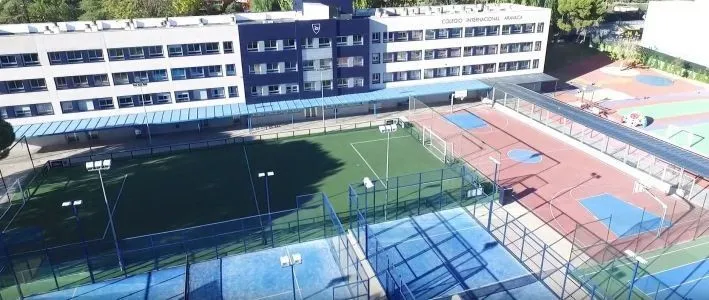
Colegio Internacional Aravaca takes this further: IB PYP, MYP, and Spanish Bachillerato, with 742 students from 35 nationalities and a teacher-to-student ratio of 1:11. Part of the International Schools Partnership (ISP) network. The Aravaca neighbourhood, in western Madrid near Casa de Campo park, is family-friendly and increasingly popular with expats.
The trade-off is real, though. If you're on a three-year posting and then moving to, say, Hong Kong, a Spanish-system school adds complexity. The Bachillerato isn't as universally recognized as IB or A-Levels for university entry in Asia or the Middle East. But if Spain might be permanent — or even long-term — this pathway is worth serious consideration.
American Curriculum
The American School of Madrid is the anchor: founded 1963, 980-1,040 students, 60+ nationalities (roughly one-third American, one-third Spanish, one-third other), located in Pozuelo de Alarcon. The campus has a 600-seat auditorium, robotics lab, and full athletic facilities. IB Diploma average of 34.5 points across 75 candidates. Class sizes average just 14 with a maximum of 22 — among the smallest in Madrid's international school market. ASM also offers the Spanish "Programa Oficial" alongside its American and IB tracks, giving families triple optionality.
Beyond ASM, the American-school landscape in Madrid is fragmented. Smaller schools like Brewster Madrid, Dragon American School, and ESC American School (EUR 16,500-35,200 for senior years) serve specific niches. Liceo Europeo in Alcobendas blends American and IB curricula for 1,300 students with impressively small classes of 18 (max 20) and instruction in five languages.
If you're American and planning to repatriate, ASM is the obvious choice. If you're not American but like the broader, extracurricular-heavy approach, Liceo Europeo offers a compelling alternative with more European flavour.
French and German
Two institutions dominate. Lycee Francais de Madrid is massive: 3,500 students, 100% pass rate on the French Baccalaureate (above the AEFE network average of 96.7%), and a central Madrid location near Arturo Soria. If you're French-speaking and want the AEFE system, this is one of the largest and most established lycees outside France. Lycee Francais International Moliere offers a smaller, bilingual French-Spanish alternative.
Deutsche Schule Madrid enrolls 1,709 students and delivers the full German curriculum through Abitur. Seventy extracurricular activities, instruction in German with English, French, and Spanish — and a diagnostic support team for learning differences. Class sizes are larger (average 26, max 28), which reflects German-system norms. If your family is German-speaking, this is your school. There isn't really a Plan B.
Fees: What You'll Actually Pay
Madrid's international schools are significantly cheaper than their equivalents in Dubai, Singapore, or London. That said, "cheap" is relative, and the range is wide. Most schools quote fees in EUR per year, often broken into three termly instalments.
Budget Tier: EUR 5,000-10,000/year (USD 5,400-10,800)
This is the domain of Spanish-system bilingual schools and the most affordable British options. Santo Angel British School at EUR 6,552-7,320 is the standout — a proper British-curriculum school at fees that would barely cover a term elsewhere. At this tier, expect larger class sizes, more basic facilities, and a student body that's predominantly Spanish. But the teaching is competent, and for families with multiple children, the savings compound dramatically.
Mid-Range: EUR 10,000-18,000/year (USD 10,800-19,400)
The sweet spot for most expat families. This is where you'll find established schools with proper international communities, reasonable class sizes, and solid extracurricular programmes. ESC American School (EUR 16,500-35,200 depending on year group) and many of the Spanish-IB hybrid schools land here. Schools at this tier typically have class sizes of 18-22, dedicated language support for non-Spanish speakers, and enough variety in their student body that your child won't be the only foreigner.
Premium: EUR 18,000-35,000/year (USD 19,400-37,800)
Where Madrid's top-tier institutions live. American School of Madrid, International College Spain, King's College Soto de Vinuelas, and Runnymede College all fall in this range for senior years. You're paying for small class sizes (14-22), world-class facilities, genuine international diversity, strong IB or A-Level results, and brand recognition that carries weight on university applications. By global standards, even Madrid's premium tier is moderate — these fees would place you in the mid-range in Dubai or the budget tier in Zurich.
A Note on Hidden Costs
Spanish schools typically include more in the base fee than their Gulf equivalents — lunch programmes are often bundled or subsidized, and uniforms are less expensive. But budget for school bus transport (EUR 1,500-3,500/year depending on distance), extracurricular activities, exam registration fees (IGCSE, A-Level, and IB exams are not cheap), and the inevitable school trips. A realistic total is 10-20% above the sticker price.
Schools Worth a Closer Look
Here are eleven schools spanning different curricula, price points, and locations. Not a ranking — the best school is the one that fits your child.
International College Spain
IB (Full Continuum) | 1,060 students | Ages 3-18 | La Moraleja
The purest IB school in Madrid. Over 45 years delivering the IB programme, Nord Anglia membership (with Juilliard and MIT partnerships), and a 2025 Diploma average of 35.2 points across 86 candidates. Average class of 20, max 22. Languages include English, Arabic, French, German, Italian, Korean, and Portuguese — reflecting a genuinely global student body. La Moraleja location puts you in the heart of Madrid's international-family corridor.
American School of Madrid
IB + American + Spanish | 1,000 students | Ages 3-18 | Pozuelo de Alarcon
Founded 1963, ASM is Madrid's most established international school. The three-way curriculum (American, IB, Spanish Programa Oficial) gives families unusual flexibility. Average class of 14 students — remarkably small. IB Diploma average 34.5 points. The one-third/one-third/one-third nationality split (American, Spanish, other) creates a balanced community where no single culture dominates. Pozuelo is an affluent western suburb with good housing stock.
King's College - Soto de Vinuelas
British + IB | 1,580 students | Ages 3-18 | Soto de Vinuelas
The British establishment choice. Founded 1969, ISI-accredited, 48 nationalities, 12-acre campus. Offers both A-Levels and IB Diploma (35.5 average, 74 candidates). The school runs three Madrid campuses, so families can start at the Chamartin infant school and progress through La Moraleja to the main Soto campus. Eighty percent of students are Spanish, which means your child will be immersed in the local culture whether you planned it or not.
Hastings School
British + IB | 1,100 students | Ages 2-18 | Arturo Soria
Founded 1971 near Arturo Soria in northeast Madrid — a convenient central location that avoids the long commutes to Pozuelo or La Moraleja. Hastings offers both A-Levels and IB Diploma, with 2024 A-Level results of 64% A*-A (well above the UK average of 27%). Over 50 nationalities. NABSS member. The dual-campus setup separates primary and secondary, giving each age group its own space. A solid all-rounder.
Runnymede College
British | 1,000 students | Ages 2-18 | La Moraleja
Old-school British education with genuine character. Founded 1967, BSO-accredited, with a house system (Austen, Newton, Locke, Keynes) that drives school culture. Thirty nationalities, class sizes of 20-25, and an iPad programme from Years 4-11 that blends tradition with technology. The La Moraleja location means you're surrounded by other international families. Runnymede doesn't try to be everything — it's British, it's rigorous, it's consistent.
Colegio San Patricio
IB + Spanish | Ages 1-18 | La Moraleja
Founded 1958 — older than most schools on this list. San Patricio represents the Spanish-international hybrid at its best: a prestigious Spanish school with a serious IB programme (33.0 average, 47 candidates). Instruction in English, French, Spanish, and German. If you want your child to genuinely integrate into Spanish society while keeping an international exit ramp via IB, this is one of the smartest choices in Madrid.
SEK International School - Ciudalcampo
IB + Spanish | 1,283 students | Ages 1-18 | Ciudalcampo
Part of Spain's oldest private education group (since 1892). Full IB continuum with class sizes from 10 (nursery) to 22 (secondary). IB Diploma average 33.2 points. NEASC-accredited, Round Square member, Duke of Edinburgh programme. SEK also operates El Castillo in western Madrid and Santa Isabel in the city centre — the last being one of the few international-quality options within the M-30 ring road.
Kensington School
British + IB | 1,100 students | Ages 1-18 | Pozuelo de Alarcon
Founded 1968 in Pozuelo, right next to ASM. British curriculum through IGCSE, then IB Diploma or Spanish Bachillerato at sixth form. NABSS member. Two indoor sports halls, interactive whiteboards across Years 1-9, and a solid extracurricular programme. The Pozuelo location means you share a neighbourhood with ASM and the British Council School, creating a critical mass of international families.
Liceo Europeo
IB + American + Spanish | 1,300 students | Ages 1-18 | Alcobendas
Founded 1982 in Alcobendas, just east of La Moraleja. The triple-curriculum option (IB, American, Spanish) with class sizes averaging 18 and capped at 20. Instruction in five languages: English, Spanish, French, Chinese, and German. Seventy percent Spanish students, 30% international from 30 nationalities. Swimming pool, padel courts, full science labs. An underrated school that delivers a genuinely multilingual education without premium-tier pricing.
St. Anne's School
British + IB | 370 students | Ages 3-18 | Chamartin
The small-school option. Founded 1969 on Avenida de Alfonso XIII in Chamartin — a proper Madrid neighbourhood, not a distant suburb. Class sizes of 15-20 (max 22) in a community of just 370 students. Your child will be known by name here. British curriculum through IGCSE with IB available. Strong SEN provision with a dedicated Additional Needs department. The central location is a genuine differentiator — your commute to school might actually be pleasant.
Colegio Internacional Aravaca
IB + Spanish Bachillerato | 742 students | Ages 2-18 | Aravaca
Part of the International Schools Partnership (ISP), Aravaca delivers IB PYP and MYP alongside the Spanish Bachillerato with an outstanding teacher-to-student ratio of 1:11 (1:9 in early years). Thirty-five nationalities, and notably, 76% international students — one of the highest ratios in Madrid. Scholarships and financial aid available. The Aravaca neighbourhood, near Casa de Campo, offers a village-like feel within the city limits.
Neighbourhoods: Where You Live Shapes Everything
Madrid's school map doesn't cluster neatly like Dubai's or Singapore's. Schools are spread across the metropolitan area, and your commute calculation will drive the decision as much as any curriculum preference. Here's the lay of the land.
La Moraleja / Alcobendas
The undisputed capital of international schooling in Madrid. International College Spain, Runnymede College, King's College La Moraleja, Colegio San Patricio, and Liceo Europeo are all here or minutes away. La Moraleja is a gated residential area with large villas, parks, and a country-club atmosphere. Rents are high but the concentration of schools means short commutes and a ready-made community of international families. Alcobendas, the adjacent town, offers more affordable housing with easy access to the same schools.
Pozuelo de Alarcon
The western counterpart to La Moraleja. American School of Madrid, Kensington School, and British Council School (2,000 students, bilingual British-Spanish, BSO-accredited) all cluster here. Pozuelo is affluent, family-oriented, and well-connected to central Madrid by Cercanias train. Housing ranges from apartments to detached houses, and the town has its own shops, restaurants, and parks. If your shortlist includes American or British schools, Pozuelo should be your first neighbourhood visit.
Arturo Soria / Conde de Orgaz / Chamartin
The in-the-city option. Hastings School, St. Anne's School, Dallington School (300 students, British, in Parque Conde de Orgaz), and the King's College Chamartin infant campus are all within the M-30 or just outside it. You sacrifice the suburban gardens and swimming pools for something more valuable: living in actual Madrid. Your children grow up hearing Spanish on the street, walking to the park, taking the Metro. The Lycee Francais de Madrid (3,500 students) is also in this zone, near Arturo Soria. Housing is predominantly apartments, with some townhouses in Conde de Orgaz.
Soto de Vinuelas / Ciudalcampo
North of La Moraleja, these residential developments host King's College Soto de Vinuelas and SEK Ciudalcampo. More space, more green, lower rents than La Moraleja — but further from the city centre. If your work is in northern Madrid or you work remotely, this area gives your family room to breathe. The trade-off is a longer commute for weekend culture and dining.
Villaviciosa de Odon
Southwest of Madrid, about 25 kilometres from the centre. Agora Madrid International School (570 students, IB + Spanish, official music conservatory), Eurocolegio Casvi (1,200 students, full IB), and ESC American School are all here. Villaviciosa is genuinely suburban — think Spanish small-town life with good schools attached. Housing is affordable by Madrid standards, and the schools have large campuses with space that central-city schools can only dream of.
Majadahonda / Aravaca
West of Madrid, between the city centre and Pozuelo. Alegra School (900 students, British + IB, co-ed in early years then girls-only) is in Majadahonda; Colegio Internacional Aravaca is in Aravaca. These neighbourhoods are popular with Spanish professional families and increasingly with expats who want a suburban feel without going as far as Pozuelo or La Moraleja. Good Cercanias connections.
Admissions: What You Need to Know
Timing
Spanish schools generally follow a September-to-June academic year. The main admissions window opens in January-March for the following September. But — and this matters — most Madrid international schools operate rolling admissions, meaning they'll accept students whenever space is available. If you're relocating mid-year, don't panic. Schools here are used to it.
That said, popular year groups fill fast. Reception (age 4-5), Year 7 (age 11-12, when many schools start secondary), and the IB Diploma entry year (age 16) are the pressure points. For top schools like ICS, ASM, or Runnymede, apply as early as possible — waiting lists exist.
Entrance Assessments
Nearly every school requires an entry evaluation. For younger children, this is usually a classroom observation or informal play session. From age 7-8 onward, expect written assessments in English and Mathematics. Some schools add cognitive ability tests (CAT4 is common in British schools). Secondary-level applicants may face interviews.
If your child is coming from a non-English-speaking system, most schools offer English as an Additional Language (EAL) support — and many will still admit the child, sometimes placing them a year below age-equivalent to allow catch-up time. Madrid schools are generally more flexible about this than their Gulf or Asian counterparts.
The Spanish Legal Framework
All private schools in Spain, including international ones, operate under regional education authority (Comunidad de Madrid) oversight. This means certain Spanish-language and social-studies content is mandatory, even in British or American schools. In practice, this is a benefit — your child gets Spanish instruction built into the school day whether you chose it or not. Some schools integrate this seamlessly; others treat it as a tick-box exercise. Ask during your visit how Spanish studies fit into the timetable.
The February Deadline Trap
Spanish private schools (including many bilingual schools that serve expats) have a strict February-March application deadline governed by the Comunidad de Madrid. Miss it and you may not be able to enroll until the following year. International schools with purely foreign curricula have more flexibility, but any school that offers the Spanish Bachillerato may be subject to these timelines. Confirm deadlines directly with each school.
Making the Decision
Madrid rewards patience. Unlike Dubai or Singapore, where you might have a three-year contract and need to optimise for that window, many families who come to Madrid end up staying. The quality of life is extraordinary — the food, the weather, the social warmth, the safety, the healthcare. And if you stay, your school choice compounds. The child who starts in a bilingual Spanish-IB programme at age 5 emerges at 18 functionally trilingual with a globally recognised diploma and access to both Spanish and international universities. That's hard to replicate anywhere else.
Visit three schools, not ten. Based on your curriculum preference, budget, and neighbourhood, shortlist three, visit them during a normal school day, and watch how the teachers interact with students. Talk to the children in the corridor — their openness and confidence tells you more than any prospectus ever will.
And remember: a school that's right for your seven-year-old might not suit your teenager. Madrid has enough options that you can switch. It's not a one-shot decision.
Explore all 75 Madrid schools on Scholae to filter by curriculum, fees, and age group. Use the compare tool to put your shortlist side by side.
Buena suerte with the move. You've picked a great city.