Poland's capital Warsaw has an international school market with a story that mirrors the city itself: rebuilt from almost nothing, growing fast, and punching well above its weight. Two decades ago, expat families arriving in the Polish capital had a handful of options and low expectations. Today there are 24 international schools serving a booming expatriate community drawn by EU institutions, tech companies, multinationals with regional HQs, and — since 2022 — a significant wave of Ukrainian families who have reshaped the student demographics in ways no one predicted.
What makes Warsaw distinctive is the combination of genuine curricular diversity and Central European pricing. You can find full IB continuum schools, British IGCSE-to-A-Level pipelines, American diploma programmes, French Baccalaureate, German Abitur, Canadian curriculum, Montessori, and forest school pedagogy — all in a city where annual tuition at a well-regarded international school costs roughly what you'd pay per term in London or Singapore. Poland's economy is the sixth-largest in the EU and growing, the zloty is stable, and Warsaw consistently ranks among Europe's safest capitals. The quality of life calculation for expat families is compelling, and the school market reflects it.
But navigating 24 schools spread across a sprawling city — from the leafy southern suburbs of Wilanow to the Vistula's right bank in Praga — requires more than a Google search. Here is what you actually need to know.
Explore all 24 Warsaw international schools on Scholae to filter by curriculum, fee range, and age group.
The Curriculum Landscape: IB and British Lead, with Real Alternatives
Warsaw's 24 schools split across roughly seven curriculum families, but the market is defined by two: International Baccalaureate and British. Together they account for the majority of places. The rest — American, French, German, Canadian, Montessori — serve specific communities and pedagogical preferences, and some of them are genuinely excellent.
International Baccalaureate (IB)
The IB is Warsaw's prestige curriculum, and the city has genuine depth here.
American School of Warsaw (ASW) is the flagship. Founded in 1953 — making it one of the oldest international schools in Central Europe — ASW sits on a spacious campus in Konstancin-Jeziorna, the affluent garden suburb south of the city. It enrolls 994 students with an average class size of 17, and offers the full IB continuum (PYP, MYP, Diploma) alongside the American High School Diploma. The dual-track approach gives families flexibility: American-style education through the middle years, then the globally portable IB Diploma or the US diploma depending on university plans. ASW is a not-for-profit, college-preparatory school with English as the sole language of instruction. For families arriving from US embassy postings or American corporate relocations, ASW is the default first stop — and for good reason.
Monnet International School holds a distinctive position: it was the first school complex in Poland to offer all three IB programmes (PYP, MYP, Diploma). Founded in 1992, Monnet enrolls around 400 students from over 30 nationalities, with classes of 20. It sits centrally on ul. Zbierska, and its fees are published transparently: PLN 40,500-49,980 per year (roughly USD 10,100-12,500). The full IB continuum means a child can enter at age 3 and graduate at 19 without a curriculum transition — a genuine advantage for families who value continuity.
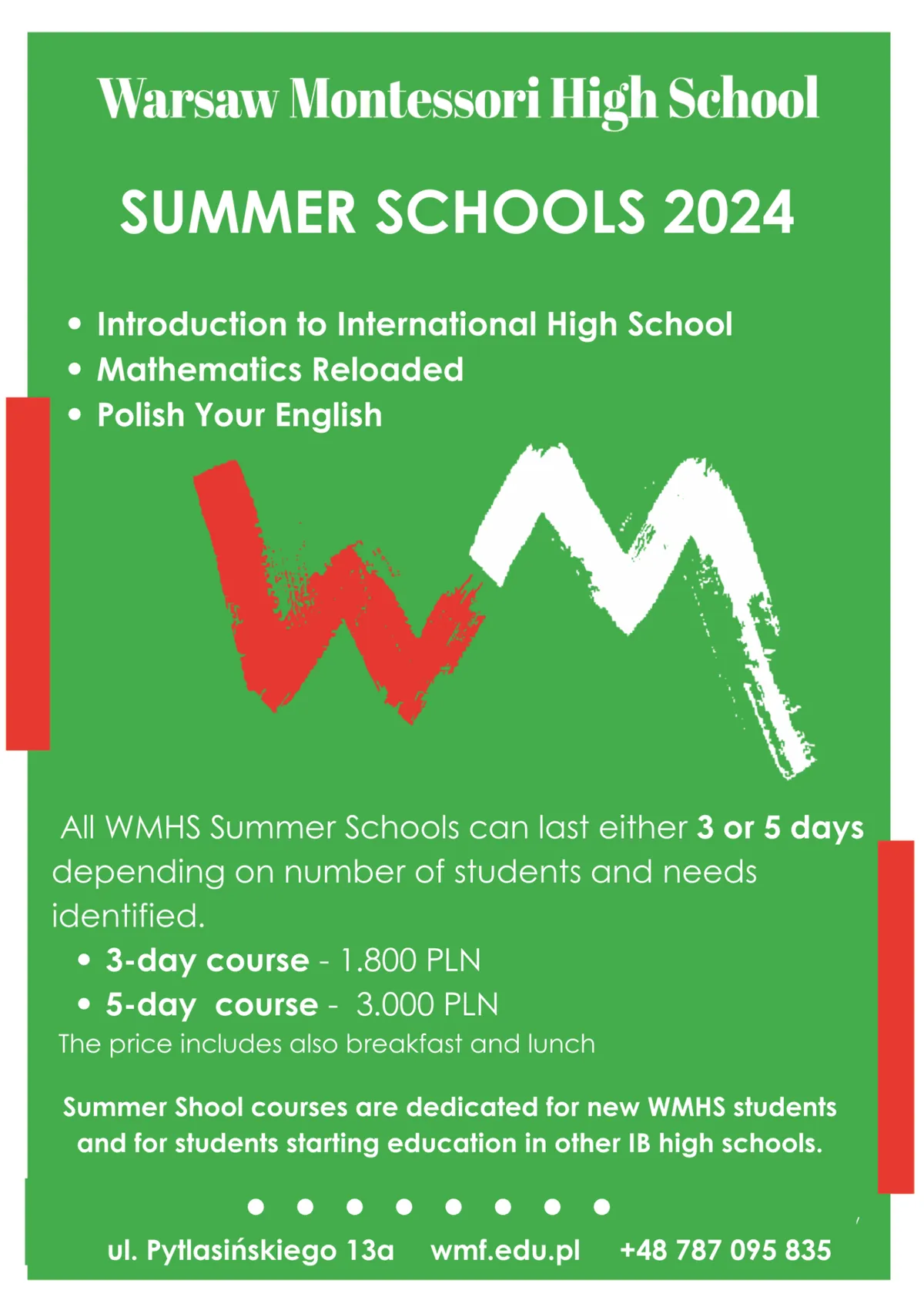
Warsaw Montessori High School offers the IB Diploma Programme within a Montessori framework — a rare combination globally, let alone in Central Europe. An IB World School serving ages 14-18, it appeals to families who want the university-recognised IB credential delivered through child-centred, Montessori-informed pedagogy. Located in the Mokotow area, it draws from the broader Warsaw Montessori Family network.
British Curriculum
The British pipeline — typically IGCSE at 14-16, then A-Levels or IB Diploma at 16-18 — has deep roots in Warsaw and produces several of the city's most established schools.
The British School Warsaw (TBS) is the giant. Part of the Nord Anglia Education network, TBS enrolls 1,248 students on its Mokotow campus at ul. Limanowskiego, with classes of 20. It offers both British curriculum (IGCSE, A-Levels) and the IB Diploma, giving students a choice of exit qualification at 16. TBS reports IB Diploma scores "significantly higher than the world average" and IGCSE results "well above the global average." The Nord Anglia affiliation brings resources — global exchange programmes, collaborations with MIT and Juilliard, standardised quality assurance — that standalone schools cannot match. Ages 2-18. For families who want scale, brand recognition, and a proven British-IB track, TBS is the benchmark.
Akademeia High School is the opposite model: small, selective, and academically intense. Founded in 2015, it serves just 280 students aged 13-18 with a remarkable student-to-teacher ratio of 3:1 and maximum class sizes of 12. The results speak for themselves: 64% A*-A at IGCSE (against a UK benchmark of 27%) and 71% A*-A at A-Level (same benchmark). BSO-accredited and a Cambridge, Edexcel, and AQA examination centre, Akademeia draws over 20 nationalities. Located on ul. Ledochowskiej in Wilanow, it is unambiguously the academic powerhouse of Warsaw's British curriculum scene. If A-Level results and Oxbridge preparation are your priority, this is the school.
Thames British School Warsaw takes a multi-campus approach: 850 students across four Warsaw locations (Ochota, Wlochy, and two in Mokotow), offering British curriculum through IGCSE and A-Levels plus the IB Diploma. Part of Dukes Education, Thames has 150+ teaching staff, 50+ nationalities, and 35+ after-school clubs. The class size of 16 is smaller than both TBS and many competitors. The distributed campus model means there is likely a Thames location within reasonable commuting distance regardless of where in Warsaw you live — a practical advantage in a city where traffic can test your patience.
British Primary School of Wilanow fills an important niche: British curriculum for ages 3-14, located in the heart of Wilanow on ul. Prymasa Augusta Hlonda. It enrolls 350 students with classes of 20 (smaller for nursery and reception), a 50:50 local-to-international ratio, and COBIS Patron's Accredited Member status — a serious quality marker. Cambridge Assessment International Education provider. For families in Wilanow and the southern suburbs who want a British primary education without the commute to central Warsaw, this is the obvious choice.
American Curriculum
Beyond ASW's IB-American hybrid, Warsaw has a dedicated American option.
International American School of Warsaw (IAS), founded in 1989, sits near Metro Kabaty in the Ursynow district. It enrolls 300 students aged 4-18 with classes of 20, offering IB, American, and Polish curricula — a triple-track approach that serves families who may move between systems. Five languages of instruction (English, French, Spanish, German, Polish) make IAS one of Warsaw's most linguistically diverse schools. The Metro Kabaty location gives it excellent public transport access, unusual for an international school.
French and German
Lycee Francais de Varsovie R. Goscinny is Warsaw's French government-supported school, and like its counterparts worldwide, it delivers extraordinary value. 770 students from 45 nationalities, average class size of 20, French Baccalaureate with a 100% pass rate in 2024 (against the AEFE network average of 96.7%). Ages 2-18. Located on the Vistula's right bank at ul. Walecznych in Praga Poludnie. If your family has any French-language connection, or if you want your child to acquire one, this is — objectively — one of the best education bargains in Warsaw. The AEFE network subsidises fees, making this dramatically cheaper than private international schools while delivering results that surpass most of them.
Willy-Brandt Schule Warschau, founded in 1978, is Warsaw's German school. 300 students, German curriculum leading to the Abitur, instruction in German and Polish with English and French. Located on ul. Sw. Urszuli Ledochowskich in Wilanow. The Abitur is recognised for university admission across Europe and increasingly worldwide. For German-speaking families or those planning university in Germany, Austria, or Switzerland, this is the clear path.
Canadian, Montessori, and Alternative Approaches
The Canadian School of Warsaw, founded in 2014, offers IB PYP alongside the Polish curriculum for ages 3-14. Located in Mokotow with three campuses, it enrolls 165 students with a 59% Polish / 41% international split. The Canadian pedagogical approach — emphasis on inquiry, collaboration, and bilingualism — gives it a distinctive feel. Uniforms required for Grades 1-6.
International Trilingual School of Warsaw is exactly what the name suggests: 650 students aged 1-14, instruction in English plus two additional languages from French, Spanish, Japanese, Chinese, and Polish. IGCSE curriculum, classes of 20, 25 nationalities represented. Located in Bialoleka on the city's northern edge. If multilingualism is your family's defining priority, ITSW offers a breadth of language instruction that no other Warsaw school matches.
Warsaw Montessori Family, on ul. Tatrzanska in Mokotow, provides the Montessori pathway from toddler through IB Diploma (ages 1-18) through its network of campuses, including the Warsaw Montessori High School for the senior years. English instruction with Polish, French, German, and Spanish available. Rolling admissions. For families committed to Montessori pedagogy who want an IB exit qualification, this is Warsaw's only complete pathway.
Fees: Central European Value
Warsaw's international school fees are among the most accessible in any major European capital. If you are relocating from London, Dubai, Singapore, or Hong Kong, the numbers will feel liberating. If you are coming from elsewhere in Central Europe — Prague, Budapest, Bucharest — they will feel broadly comparable, with Warsaw offering more depth of choice.
Budget Tier: PLN 30,000-40,000/year (USD 7,500-10,000)
Multischool International School publishes fees at PLN 39,384/year (approximately USD 9,850) for its British-Polish bilingual programme, ages 2-13, with class sizes of 16. The Lycee Francais, while it does not publish fees on Scholae, follows the AEFE subsidised model that typically lands well below private international school rates. Schools in this bracket tend to be smaller, community-oriented, and often bilingual with Polish.
Mid-Range: PLN 40,000-55,000/year (USD 10,000-13,750)
This is where the market's centre of gravity sits. Monnet International School at PLN 40,500-49,980 for its full IB continuum, Thames British School, and most of Warsaw's established British-curriculum schools fall in this range. You are getting class sizes of 16-20, proper accreditation, multiple nationalities, and the full suite of extracurricular programmes. In London, these fees would not cover a single term at an equivalent school.
Premium Tier: PLN 55,000+/year (USD 13,750+)
The British School Warsaw (Nord Anglia) and American School of Warsaw sit at the top of the market. Neither publishes headline fees on Scholae, but the institutional scale, network affiliations, and breadth of programmes command premium pricing. Even so, Warsaw's "premium" would be solidly mid-range in Dubai and barely entry-level in Singapore or Hong Kong.
The Real Comparison
A family paying PLN 50,000/year (USD 12,500) for a COBIS-accredited British school in Warsaw would pay GBP 20,000-35,000 (USD 25,000-44,000) for an equivalent in London, AED 50,000-80,000 (USD 13,600-21,800) in Dubai, and SGD 30,000-45,000 (USD 22,500-33,750) in Singapore. Warsaw is not inexpensive because the education is inferior — it is inexpensive because the Polish cost structure is lower, the market is competitive, and the city has not yet experienced the speculative fee inflation that hits "destination" expat markets.
Hidden Costs
Factor in school bus transport (many Warsaw schools offer this, typically PLN 5,000-12,000/year depending on distance), uniforms for British schools, exam registration fees for IGCSE, A-Levels, and IB, and extracurricular activities. Lunch is typically provided by the school for an additional fee. A realistic budget adds 10-15% above published tuition.
Schools Worth a Closer Look
Here are ten schools spanning different curricula, price points, and locations. Not a ranking — the best school is the one that fits your family.
American School of Warsaw
IB (Full Continuum) + American | 994 students | Ages 3-18 | Konstancin-Jeziorna
Warsaw's oldest international school (1953) and its most established. The Konstancin-Jeziorna campus gives students space and green surroundings, though the location means a commute from central Warsaw. Class sizes of 17 are among the smallest at this scale. The IB-American dual track is the school's defining feature: families get the flexibility of both systems without committing early. Not-for-profit status means fees go back into the school. If you are arriving on a US diplomatic or corporate posting, ASW is where your predecessors sent their children — and the institutional memory shows.
The British School Warsaw
British + IB | 1,248 students | Ages 2-18 | Mokotow (ul. Limanowskiego)
The Nord Anglia flagship. The Mokotow location is more central than ASW's Konstancin campus, which matters for daily life. IB Diploma results consistently above the world average, IGCSE results equally strong. The Nord Anglia network provides global mobility — if you relocate to another Nord Anglia city, your child's educational continuity is built in. 1,248 students means breadth: more subject choices, more sports teams, more clubs. The trade-off is that you are choosing a corporate-backed education model, not a local independent. For many families, that is precisely the point.
Akademeia High School
British (IGCSE + A-Levels) | 280 students | Ages 13-18 | Wilanow
The academic outlier. A 3:1 student-to-teacher ratio, maximum class sizes of 12, and results that would be exceptional anywhere: 71% A*-A at A-Level, 64% A*-A at IGCSE. BSO-accredited, Cambridge and Edexcel examination centre. Twenty nationalities in 280 students. The school opened in 2015, so it lacks the decades-long track record of ASW or TBS, but the results and the model — small, selective, rigorous — are hard to argue with. If your child is academically ambitious and would thrive in a small, intense environment, Akademeia is the conversation.
Monnet International School
IB (Full Continuum) | ~400 students | Ages 3-19 | Central Warsaw
Warsaw's original full-continuum IB school, founded 1992. The central location, transparent fee structure (PLN 40,500-49,980), and 30+ nationalities make Monnet the mid-market IB choice for families who want continuity from nursery through the Diploma. Class sizes of 20 are manageable. The school does operate a waiting list, so apply early for popular year groups. For families who are philosophically committed to the IB approach from early years onward, Monnet is one of the few Warsaw schools that delivers the complete pathway without curriculum switches.
Thames British School Warsaw
British + IB | 850 students | Ages 3-18 | Four campuses (Ochota, Wlochy, Mokotow)
The multi-campus model is Thames's defining feature. Four locations across western and southern Warsaw mean shorter commutes for more families. Class sizes of 16 are among the smallest of the larger schools. British curriculum through IGCSE and A-Levels, plus IB Diploma — so students choose their exit qualification at 16. Fifty nationalities, 150+ staff, 35+ clubs. Part of Dukes Education. The distributed model means each campus has a smaller, more community feel than the headline enrolment number suggests. Visit the specific campus your child would attend, not just the flagship.
Lycee Francais de Varsovie R. Goscinny
French Baccalaureate | 770 students | Ages 2-18 | Praga Poludnie
The value play — and more than that. A 100% French Baccalaureate pass rate in 2024, 45 nationalities, 770 students, and AEFE-subsidised fees that make every other school on this list look expensive. The Praga Poludnie location on the Vistula's right bank puts it in one of Warsaw's most rapidly gentrifying districts — trendy restaurants, Saska Kepa's tree-lined streets, and a very different vibe from the corporate Mokotow corridor. Instruction in French and Polish, with English available. If your family speaks French, this is objectively the strongest value proposition in Warsaw. If you do not, it is worth learning.
British Primary School of Wilanow
British (Cambridge) | 350 students | Ages 3-14 | Wilanow
COBIS Patron's Accredited — a rigorous quality standard that not every British school in Warsaw holds. Cambridge Assessment International Education provider. 350 students, classes of 20 (smaller for younger years), 35 nationalities, and a 50:50 local-international split that gives the school a genuinely bicultural character. The Wilanow location puts it in the heart of one of Warsaw's fastest-growing family neighbourhoods, surrounded by parks, new-build apartments, and the Wilanow Palace grounds. For families in the southern suburbs who want a British primary without the daily commute north, this is the answer.
International American School of Warsaw
IB + American + Polish | 300 students | Ages 4-18 | Ursynow (Metro Kabaty)
The triple-track school: IB, American, and Polish curricula under one roof. Founded 1989, 300 students, classes of 20, five languages of instruction. The Metro Kabaty location gives IAS something rare in international schooling: excellent public transport access. Students can commute independently from secondary age onward — a small thing that transforms family logistics. For families who may move between Polish and international systems, or who want the safety net of a recognised Polish qualification alongside the IB or American diploma, IAS threads the needle.
International Trilingual School of Warsaw
IGCSE | 650 students | Ages 1-14 | Bialoleka
Six languages of instruction — English, French, Spanish, Japanese, Chinese, and Polish — in a single school. That alone makes ITSW unique in Warsaw. 650 students from 25 nationalities, classes of 20, IGCSE curriculum. The Bialoleka location is the city's northern frontier, which means longer commutes from the popular southern suburbs but also more affordable housing and green space. If languages are your family's defining educational priority, no other Warsaw school comes close.
Willy-Brandt Schule Warschau
German (Abitur) | 300 students | Ages 3-18 | Wilanow
Founded 1978, the German school serves a specific but important community. The Abitur is one of the world's most respected secondary qualifications, recognised across Europe for university admission without additional entrance exams. 300 students, German and Polish instruction, with English and French. The Wilanow location clusters it near Akademeia and the British Primary School — three very different schools within walking distance of each other. For German-speaking families, or those planning higher education in the DACH region, this is the clear path.
Neighbourhoods: Where Schools Cluster
Warsaw is a sprawling city — 517 square kilometres, larger than many European capitals — and the school geography matters more than in compact cities like Prague or Vienna. Knowing where the schools cluster can shape where you choose to live.
Mokotow and Sadyba (South-Central)
Warsaw's most popular expat district, and for good reason. The British School Warsaw sits on ul. Limanowskiego. The Canadian School of Warsaw has its campuses here. Warsaw Montessori Family is on ul. Tatrzanska. Thames British School operates its high school campus in Mokotow. The neighbourhood itself offers parks (Pole Mokotowskie is massive), international restaurants, easy metro access, and housing stock ranging from communist-era blocks (renovated, surprisingly liveable, and affordable) to sleek new-build apartments. Rents for a family apartment run PLN 5,000-9,000/month (USD 1,250-2,250) — comfortable for most expat budgets.
Wilanow (South)
Once the far southern edge of the city, now a booming residential district centred on the 17th-century Wilanow Palace and its surrounding parks. Akademeia High School, British Primary School of Wilanow, Willy-Brandt Schule, and Edison International School all cluster here. Wilanow attracts families who want new-build housing, green space, and a suburban feel within city limits. The trade-off: limited metro access (bus and car dependent) and a 30-40 minute commute to the city centre in traffic. But if your school is in Wilanow, living there eliminates the commute entirely.
Konstancin-Jeziorna (South, Beyond City Limits)
Technically a separate municipality, Konstancin is Warsaw's answer to Greenwich or Hampstead: tree-lined streets, villas with gardens, a spa-town heritage, and — critically — the American School of Warsaw. ASW families typically live in Konstancin or the Wilanow-Konstancin corridor. It is 20-30 minutes from central Warsaw by car, longer at rush hour. Housing is expensive by Polish standards (rents PLN 8,000-15,000/month for a villa), but families get space, safety, and the closest thing to American-style suburban living that Warsaw offers.
Ochota and Wlochy (West)
Thames British School has campuses in both districts. Sapiens International Community School is on Grojecka in Ochota. These western districts are well-connected by tram and bus, more affordable than Mokotow, and increasingly popular with younger expat families who want to be in the city rather than the suburbs. Ochota borders the massive Pole Mokotowskie park and the university district — a lively, urban environment.
Praga Poludnie (East Bank)
The Lycee Francais on ul. Walecznych anchors the east-bank school scene. Praga has transformed from Warsaw's grittiest district into its most artistically interesting — Saska Kepa's interwar villas, the Neon Museum, independent cafes, and a creative energy that the polished west bank lacks. Housing is 20-30% cheaper than Mokotow for comparable space. The Lycee Francais community has helped build an international presence in Saska Kepa that feels distinct from the corporate expat bubble south of the river.
Bialoleka (North)
International Trilingual School of Warsaw is the primary international option in the north. Bialoleka is Warsaw's fastest-growing residential district — new housing estates, families with young children, green spaces, but limited cultural infrastructure. If ITSW is your school, Bialoleka offers the shortest commute and the most affordable family housing in Warsaw. Otherwise, the distance from the rest of the international school ecosystem is a consideration.
Admissions: What to Know
Timing
Warsaw follows the Polish academic year: September to late June. The main admissions cycle runs January through April for the following September. Most international schools accept rolling admissions — Warsaw's expat population shifts with corporate transfers and diplomatic postings, and schools are pragmatic about mid-year arrivals. That said, the top schools (ASW, TBS, Akademeia) can have waiting lists for popular year groups, so apply as early as possible.
Entrance Assessments
Every school evaluates, but the intensity varies. Younger children (ages 2-5) typically do a classroom observation or play-based trial day. From primary age, expect written assessments in English and Mathematics. Akademeia requires entrance exams followed by interviews — reflecting its selective, academic ethos. ASW is a full college-preparatory model: MAP testing, transcripts, references. British Primary School of Wilanow uses a one-day trial with skill assessment and English proficiency verification. The International Trilingual School tests by level and expects a registration deadline by end of June.
The Polish Language Question
Unlike some Central European cities where the local language is an optional add-on, Polish matters in Warsaw — and increasingly, the international schools acknowledge this. Many schools (Monnet, IAS, Thames, British Primary Wilanow) offer Polish instruction alongside the international curriculum. The Canadian School and Multischool are explicitly bilingual English-Polish.
If you are staying in Poland longer than two years, a school with serious Polish instruction gives your child social capital that extends far beyond the classroom. Polish is difficult — the grammar is fearsome, the pronunciation takes time — but children absorb it in ways that stun their parents. And a child who speaks Polish will have a fundamentally different experience of life in Warsaw than one who does not.
The Ukrainian Factor
Since 2022, Warsaw's international schools have absorbed a significant number of Ukrainian families. This has changed classroom demographics, added Ukrainian to the language mix at several schools, and created waiting-list pressure at some year groups that did not exist before. It has also enriched the student body in ways that schools and families report positively: more linguistic diversity, more cultural awareness, and a generation of children who understand displacement and resilience in ways their textbooks never could.
Making the Decision
Warsaw rewards families who do their homework. The market is large enough to offer real choice — IB or British or American, 17-student classes or 280-student schools, Konstancin villas or Mokotow apartments — but small enough that you can visit five schools in two days and form genuine impressions.
Start with curriculum. If you want IB, the conversation is ASW (established, American-IB, Konstancin) versus Monnet (full continuum, central, transparent fees) versus Thames or TBS (British-to-IB at 16). If you want British, it is TBS (scale, Nord Anglia network) versus Akademeia (small, selective, extraordinary results) versus Thames (multi-campus, smaller classes). If you want something different — French, German, Montessori, trilingual — the options are clear and specific.
Then narrow by geography. Warsaw traffic in winter is miserable. A school that is 8 kilometres away can take 45 minutes by car in November rain. Live near the school, or choose a school near where you want to live. The Mokotow-Wilanow corridor gives you the densest cluster of options. Konstancin works if ASW is your school. Praga if the Lycee Francais calls to you.
Visit during a normal school day, not an open house. Watch the transitions between classes. Listen to which languages the children speak to each other — not to the teachers, but to each other. In Warsaw, that multilingual playground chatter — Polish, English, Ukrainian, French, German switching mid-sentence — tells you everything about whether a school has truly built an international community or merely enrolled international passport holders.
One last thing: Warsaw in winter is dark and cold. The school day starts in darkness and often ends in it too. The schools that handle this well — with bright, warm interiors, indoor sports facilities, and after-school programmes that keep children engaged until parents finish work — make a material difference to family life from November through March. Ask about after-school care, clubs, and indoor facilities. In a city where winter lasts five months, the answer matters more than the prospectus photos of children playing in June sunshine.
Powodzenia. You have picked a city that is going places — and so will your children.
Explore all 24 Warsaw schools on Scholae to filter by curriculum, fees, and age group. Use the compare tool to put your shortlist side by side.