Belgium's capital Brussels is not a normal expat city. It is the de facto capital of the European Union, the headquarters of NATO, and the seat of more international organisations per square kilometre than anywhere else on earth. This produces a school market that is unlike any other — one shaped not by the usual expat dynamics of corporate relocation and diplomatic posting, but by the structural reality that tens of thousands of families are here because of the institutions themselves.
The result: 26 international schools serving a population that is, by any measure, extraordinarily international. In most cities, "international school" means "school for expats." In Brussels, it often means "school where Belgian children are the minority in a classroom of 50 nationalities, and where the parents work in policy, diplomacy, development, and law across three languages before lunch." The expectations are different. The language environment is different. And the presence of the European Schools — a curriculum system that exists almost nowhere else — creates an entire tier of education that families arriving from London, Dubai, or Singapore will not have encountered before.
Here is what you need to know.
Explore all 26 Brussels international schools on Scholae to filter by curriculum, fee range, and age group.
The Curriculum Landscape: European Schools, IB, British, and Beyond
Brussels' 26 schools span at least seven distinct curricular traditions: the European Schools system, International Baccalaureate, British (Cambridge/A-Levels), French, German, American, and Montessori. But the real story is the dominance of two tracks that, between them, educate the vast majority of internationally-minded children in the city: the European Schools and the IB.
The European Schools: Brussels' Unique Institution
No guide to Brussels schools can begin anywhere else. The four European Schools — European School Brussels I, European School Brussels II, European School Brussels III, and European School Brussels IV — are the backbone of international education in this city. Founded to educate the children of EU institution staff, they follow the European Schools curriculum and award the European Baccalaureate, a qualification recognised by universities across the continent and beyond.
The numbers are staggering. European School Brussels I alone has 4,000 students. European School Brussels IV in Laeken has 3,000. Across the four schools, you are looking at well over 12,000 pupils — more than the entire international school market of many capital cities. Instruction is offered in language sections — Danish, Dutch, English, French, German, Greek, Hungarian, Italian, Polish, Portuguese, Romanian, Spanish, Swedish, and more. Your child is taught in their mother tongue, with a second and third language integrated from early primary. The multilingual depth is genuine and unmatched by any other school system in the world.
The catch: priority access goes to children of EU institution employees (Categories I and II). If you work for the European Commission, the European Parliament, the Council, or an affiliated body, your children have a right to enrol. If you do not, places may be available in Category III — but waiting lists can be long, and they vary dramatically by language section and school. The French and English sections are the most oversubscribed. Smaller language sections (Hungarian, Romanian, Swedish) often have spaces.
The European Schools are effectively free for Category I families — fees are covered by the institutions. For Category III families (those without EU institution affiliation), annual fees apply but remain modest by international school standards.
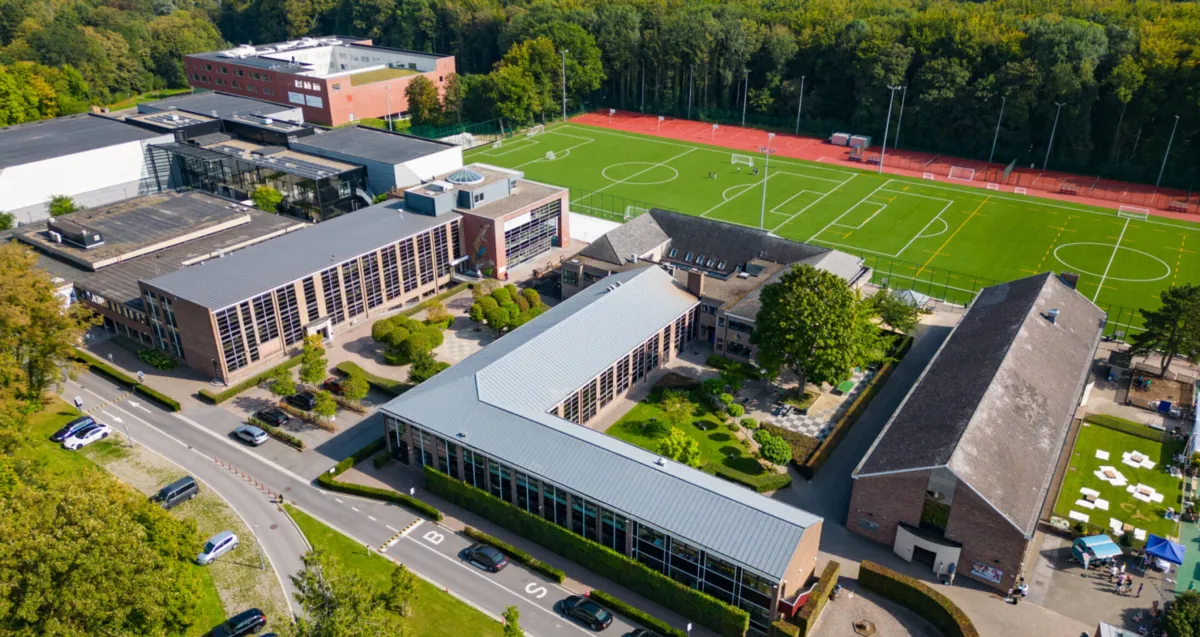
One important alternative in this system: European School of Bruxelles-Argenteuil, located in Waterloo. With 400 students from 48 nationalities, it offers the European Schools curriculum alongside IB and Montessori programmes. Class sizes average 17. This is the school for families who want the European Schools ethos — multilingual, multicultural, rooted in European identity — without the bureaucratic enrolment hierarchy of the four official schools. The Waterloo campus, with its green grounds, rugby pitch, climbing wall, and tennis courts, provides the space that the city-centre European Schools often lack.
International Baccalaureate (IB)
The IB is Brussels' other dominant international curriculum, and several schools here rank among Belgium's strongest.
The International School of Brussels (ISB) is the city's flagship IB school. Founded in 1951, it enrols 1,312 students from over 60 nationalities, with class sizes capped at 22 (averaging 19-20). The full IB continuum — PYP, MYP, and Diploma — runs through the school. Located next to the Foret de Soignes, near a UNESCO World Heritage Site, the campus setting is exceptional for a city school. ISB has embraced technology with one-to-one computing from Grade 3 and AI-integrated learning. Rolling admissions. Instruction in English. If you want the premium IB experience in Brussels, ISB is where the conversation starts.
Bogaerts International School offers IB PYP and MYP to 450 students from 50 nationalities, with a deliberate one-third Belgian, two-thirds international student mix. Class sizes average 16, capped at 20. The 2024 IB Diploma average of 33.5 points (against a global benchmark of 30.5) signals strong academic performance. Located on Rue Engeland in Uccle, the school takes a project-oriented approach emphasising curiosity and creative learning. Uniforms required. For families who want a mid-sized IB school with genuine local integration, Bogaerts is worth a visit.
BEPS International School, on Avenue Franklin Roosevelt in Ixelles, is the boutique IB option. Founded in 1972, it has just 280 students from 40 nationalities, with class sizes averaging 15 (maximum 18). Full IB curriculum. The location — right on one of Brussels' grand avenues, steps from the ULB campus and the Bois de la Cambre — is superb. The school finishes early on Wednesdays (12:30), following the Belgian tradition. Facilities include a maker space, mindfulness room, and science lab. BEPS proves that IB education does not require a 1,000-student campus; sometimes the small-school intensity is exactly what a child needs.
Montgomery International School serves 210 students from 54 nationalities with IB PYP and MYP. Class sizes of 15, maximum 18. Located on Rue du Duc in Woluwe-Saint-Lambert, near the Montgomery metro and the Cinquantenaire Park. English or English-French bilingual options. The 2025 IB Diploma average of 29.9 (14 candidates) is below the global benchmark — the small cohort makes averages volatile, so look at the school holistically rather than fixating on a single year's results. The "family atmosphere" claim is, for once, justified by the numbers: 210 students is genuinely intimate.
The Courtyard International School of Tervuren takes the IB in a distinctive direction. Just 210 students from 53 nationalities, class sizes of 12-15, and a curriculum that includes forest school and farm school programmes alongside the IB PYP, MYP, and the less common IB Career-related Programme (CP). Housed in renovated National Heritage buildings in Tervuren, the school emphasises what it calls "the ecology of childhood." Trilingual instruction in English, French, and Dutch. For families drawn to alternative pedagogies but wanting the IB credential, Courtyard is one of the most interesting schools in Brussels.
British Curriculum
Brussels has a strong British school presence, anchored by one institution that dominates the market.
The British School of Brussels (BSB) is the city's premier British school — and one of Belgium's best schools full stop. Founded in 1969, it enrols 1,350 students from 70 nationalities on a 10-hectare campus in Tervuren. The school offers three pre-university routes: IB Diploma, A-Levels, and BTEC — a flexibility that few British schools abroad provide. The 2025 IB Diploma average of 35.4 points is well above average and places BSB among the top IB schools in the Benelux. BSO (British Schools Overseas) accredited and UK Government inspected. A French-English bilingual programme runs from ages 4 to 14. Class sizes of 21 (dropping to 16 in Years 12-13). Swimming pool, sports arena, gymnasium. Admissions at admissions@britishschool.be.
ISF Waterloo International School, on the Chaussee de Waterloo in Rhode-Saint-Genese, offers the British curriculum through IGCSE and A-Levels to 235 students from 52 nationalities. Class sizes average just 14. CIS, BSO, and COBIS accredited — a triple accreditation that signals serious quality assurance. The small scale and southern location make ISF Waterloo the natural choice for families in the Waterloo-Rhode-Saint-Genese corridor who want a British education without commuting to Tervuren.
ACE of Brussels, in Auderghem, is the smallest British school in the city: around 80 students, class sizes averaging 10, maximum 16. Cambridge International accredited. The school explicitly positions itself as inclusive, with on-site speech therapy, occupational therapy, and specialised learning support programmes (ACE RISING, ACE PLUS, ACE CONNECT). For children who need more individualised attention than a 1,350-student school can provide, ACE fills a genuine gap.
Brussels International Catholic School combines the British Cambridge curriculum with Catholic ethos and English-French bilingual instruction. Founded 2004, 550 students from 45 nationalities, located on Rue Froissart in the EU quarter. IGCSE and A-Levels. For families wanting a faith-based British education in the centre of Brussels, this is the primary option.
French Curriculum
Lycee Francais Jean Monnet is one of the largest French schools outside France: 2,700 students, founded in 1907, on Avenue du Lycee Francais in Uccle. The 2024 French Baccalaureate pass rate was 99%, against an AEFE network average of 96.7%. An International Section offers approximately 50% instruction in English — making this a genuine bilingual option, not just a school for Francophones. Instruction also available in German and Spanish sections. Four additional languages offered including Dutch, Chinese, Italian, and Latin. AEFE member. For French-speaking families or those who want their children deeply bilingual in French and English, Jean Monnet is the obvious choice — and with 2,700 students, the breadth of academic, sporting, and cultural offering is enormous.
German Curriculum
International German School of Brussels (iDSB), in Wezembeek-Oppem east of the city, educates 600 students from 30 nationalities through the German curriculum to Abitur. Founded in 1803 — making it the oldest international school in Brussels by a considerable margin. Class sizes of 20, instruction in German with English and French, additional languages including Spanish, Dutch, and Latin. Scholarships and financial aid available. The school occupies a quiet suburban setting with two gymnasiums and playing fields. For German-speaking families, iDSB is the natural home; for others, the Abitur is fully recognised by European universities and increasingly by institutions worldwide.
American Curriculum
Brussels American School (BAS) is a DoDEA (Department of Defense Education Activity) school on Rue Froissart in the EU quarter. Founded 1966, 270 students. This is important context: as a US military-affiliated school, enrolment priority goes to Department of Defense dependents, and spaces for non-DoD families may be limited. If you are eligible, however, the school offers an American curriculum at essentially no cost to military families. Extracurriculars include Model UN, varsity sports, jazz band, and drama.
Fees: The Brussels Reality
Brussels' international school fee landscape is harder to summarise than most cities, because the European Schools — which educate the majority of internationally-mobile children — operate on a fundamentally different economic model than the private international schools.
European Schools: Free to Subsidised
For Category I families (EU institution employees), the European Schools are free — fees are covered by the parent's institution. For Category III families, annual fees are modest relative to the private market, typically ranging from EUR 3,000-5,000. This creates an enormous fee advantage that shapes the entire market: if you can get your child into a European School, the financial pressure largely disappears.
Budget Tier: Under EUR 12,000/year (USD 13,100)
Schools like BEPS International School, Bogaerts International School, Montgomery International School, and ACE of Brussels — the smaller, independent schools — tend to price in this range. Brussels is not Dubai or Singapore; Belgium's regulatory environment and cost structure keep fees more moderate than the headline international school cities.
Mid to Premium Tier: EUR 12,000-30,000/year (USD 13,100-32,700)
The International School of Brussels and The British School of Brussels sit at the top of the market. These are large, fully-accredited, campus-based schools with the facilities, results, and institutional depth to justify premium pricing. Even so, the top end of Brussels' market is significantly below what you would pay for equivalent schools in London, Geneva, or Singapore.
The Hidden Variable: Employer Support
More than in most cities, Brussels school fees are shaped by who your employer is. EU institutions cover European School fees. NATO provides education allowances. Many embassies, international organisations, and multinational corporates in Brussels offer school fee support as part of relocation packages. Before you compare sticker prices, check your contract — there is a reasonable chance that some or all of the cost is covered.
Schools Worth a Closer Look
Here are ten schools across different curricula and price points. Not a ranking — the best school is the one that fits your child, your family's languages, and your likely trajectory.
The British School of Brussels
British + IB + BTEC | 1,350 students | Ages 1-18 | Tervuren
The all-rounder. Three pre-university routes, 70 nationalities, a 10-hectare campus, IB Diploma average of 35.4, and BSO accreditation. The Tervuren location is leafy and spacious but means a commute for families in central Brussels or the southern communes. The French-English bilingual programme (ages 4-14) is a genuine differentiator — most British schools abroad are English-only. If you want institutional scale, academic rigour, and curricular flexibility under one roof, BSB is the benchmark.
The International School of Brussels
IB (Full Continuum) | 1,312 students | Ages 3-18 | Watermael-Boitsfort
Brussels' premier IB school. The Foret de Soignes campus, 60+ nationalities, class sizes of 19-20, and a progressive approach to technology and learning. Rolling admissions — unusual for a school of this quality. The 1951 founding date makes ISB one of the oldest international schools in Europe. If IB is your curriculum and you want the established, resource-rich experience, this is the school.
Bogaerts International School
IB (PYP + MYP + Diploma) | 450 students | Ages 3-18 | Uccle
The mid-sized IB option with strong results (33.5 IB Diploma average in 2024) and a deliberate Belgian-international student mix. Class sizes of 16. The Uccle location puts you in one of Brussels' most desirable residential communes. The project-oriented, curiosity-driven pedagogy is backed by outcomes, not just brochure language. A school that takes integration seriously without losing its international character.
BEPS International School
IB | 280 students | Ages 2-18 | Ixelles
The boutique option. Fifteen students per class, 40 nationalities, a maker space and mindfulness room, and a location on Avenue Franklin Roosevelt that is hard to beat. Founded in 1972, BEPS has half a century of experience educating Brussels' international community at an intimate scale. Early finish on Wednesdays. If your child thrives in smaller settings where every teacher knows their name, BEPS delivers.
Lycee Francais Jean Monnet
French Baccalaureate | 2,700 students | Ages 2-18 | Uccle
A 99% Baccalaureate pass rate, 2,700 students, founded 1907, and the International Section that makes it genuinely bilingual. Jean Monnet is not just a school for French families — the English-stream option opens it to anyone who wants deep French-English bilingualism. The scale is a feature: with 2,700 students, the subject range, sports teams, cultural activities, and alumni network are vast. AEFE membership means French government quality assurance. And the fees, subsidised by the French state, are dramatically lower than comparable private schools.
The British School of Brussels and ISF Waterloo International School
British (IGCSE + A-Levels) | 235 students | Ages 3-18 | Rhode-Saint-Genese
ISF Waterloo is the small British school for the southern suburbs. Class sizes of 14, triple-accredited (CIS, BSO, COBIS), 52 nationalities. If BSB in Tervuren is too far or too large, ISF Waterloo provides the British curriculum in a more intimate setting closer to the Waterloo corridor. The accreditation credentials are impeccable for a school of this size.
The Courtyard International School of Tervuren
IB (PYP + MYP + CP) | 210 students | Ages 18 months-18 | Tervuren
The alternative IB. Forest school, farm school, heritage buildings, 12-15 students per class, and the rare IB Career-related Programme alongside PYP and MYP. Trilingual in English, French, and Dutch. The Courtyard is for families who believe education should be rooted in the natural world and who want the IB framework without the institutional feel of a 1,000-student school.
International German School of Brussels
German + Abitur | 600 students | Ages 3-18 | Wezembeek-Oppem
Founded 1803. Two centuries of continuous operation. The German curriculum through Abitur, with instruction in German, English, and French. Scholarships and financial aid available — rare among Brussels' international schools. For German-speaking families, iDSB is home. For others, the Abitur is a rigorous, internationally recognised qualification, and the school's trilingual environment reflects Brussels itself.
European School of Bruxelles-Argenteuil
European Schools + IB + Montessori | 400 students | Ages 3-18 | Waterloo
The accessible European School alternative. No Category I/II priority system — open to all families. European Baccalaureate and IB pathways, Montessori pedagogy in early years, 48 nationalities, class sizes of 17. The Waterloo campus has outdoor space that the city-centre European Schools cannot match. If you want the European Schools ethos without the enrolment bureaucracy, Argenteuil is the answer.
International Montessori Schools
IB + Montessori | 350 students | Ages 2-18 | Woluwe
Montessori pedagogy with IB MYP for the secondary years, 50+ nationalities, trilingual instruction in English, French, and Dutch. Located in Sint-Stevens-Woluwe. The Montessori-to-IB pathway gives children the child-led early years experience with a globally recognised credential at the end. Maximum class ratio of 1:12, with two trained teachers per group. For families committed to Montessori who also want academic portability, this combination works.
Neighbourhoods: Where Schools Cluster
Brussels' school geography follows its commune structure — and understanding the communes is essential for navigating both housing and schooling.
Uccle and Ixelles (South-Central)
The expat heartland. Lycee Francais Jean Monnet, Bogaerts International School, and BEPS International School are all here. Uccle is leafy, residential, and home to many EU and NATO families. Ixelles is younger, more urban, with Avenue Louise shopping and the ULB university campus. The Bois de la Cambre and Foret de Soignes provide green space. Housing: apartments EUR 1,200-2,500/month; houses EUR 2,000-4,500/month. This is where you live if you want walkability, cafes, and schools within cycling distance.
Tervuren (East)
The British school corridor. The British School of Brussels, ISF Tervuren International School, and The Courtyard International School of Tervuren are all in or near this leafy commune east of the city, connected by the historic Tervuren tram (Line 44) to Montgomery and central Brussels. Tervuren is where the British community has traditionally settled — the Tervuren British Community is one of the oldest expat groups in Belgium. The Africa Museum, the park, and the proximity to the Foret de Soignes make it feel more like a wealthy English market town than a Brussels suburb. Housing: villas and family homes EUR 1,800-4,000/month.
Woluwe-Saint-Lambert and Woluwe-Saint-Pierre (East-Central)
The EU quarter spillover. Montgomery International School is here, near the Montgomery roundabout. The two Woluwes are residential, well-connected by metro, and popular with families who work in the EU institutions on Schuman but want more space than Ixelles provides. International Montessori Schools is in Sint-Stevens-Woluwe, just east. Quieter than Uccle, more urban than Tervuren. Housing: EUR 1,100-2,200/month for family apartments.
Waterloo and Rhode-Saint-Genese (South)
The southern suburbs. ISF Waterloo International School and European School of Bruxelles-Argenteuil serve this corridor. Waterloo — yes, that Waterloo — is a prosperous, family-friendly town 15 kilometres south of central Brussels. Large houses with gardens, a town centre with restaurants and shops, and a significant anglophone community. The commute to central Brussels is 30-40 minutes by car, longer by public transport. Families here have chosen space and lifestyle over proximity. Housing: EUR 1,500-3,500/month for family homes.
The EU Quarter and Schaerbeek (Central-North)
Brussels American School, Brussels International Catholic School, and The British International School of Brussels cluster near the EU institutions. Living and schooling in the same quartier means short commutes and the energy of central Brussels — but also less green space and smaller living quarters. Practical for single-posting families who want urban convenience.
Admissions: What to Know
The European School Queue
If you are eligible for the European Schools (Category I or II), apply as early as possible. The enrolment process is managed centrally, and popular language sections — particularly English and French — fill quickly. Category III applications open later and depend on available spaces. Check with your institution's HR department; they will have navigated this process hundreds of times.
For Private International Schools
Most Brussels international schools operate rolling admissions — the transient nature of the city's international population means children arrive and depart throughout the year. That said, applications for September entry are strongest when submitted by January-March.
Standard requirements across schools:
- Ages 2-5: Classroom observation or play-based assessment
- Ages 6+: Written assessments in English (and sometimes Mathematics)
- Secondary: Interviews, previous school reports, and sometimes standardised test results
- ISB requires academic transcripts and may ask for teacher recommendations
- BSB requires an admissions assessment and interview
- Bogaerts has an entry evaluation with reports from previous schools
The Language Question
Brussels is officially bilingual (French and Dutch), with the EU adding English, German, and every other European language into daily life. Your child will hear French in shops, Dutch in Flemish communes, English in the EU quarter, and likely several others on the school bus. This multilingual immersion is one of Brussels' greatest educational assets — but it also means the language of instruction matters more than in a monolingual city.
Schools like The British School of Brussels, Lycee Francais Jean Monnet, and The Courtyard offer genuine bilingual or trilingual programmes. If you are staying in Brussels for more than two or three years, French proficiency is not optional for quality of life — and a school that integrates it from the start will save your child from playing catch-up later.
Coming from Another EU Capital?
If you are transferring from a European School in Luxembourg, Mol, or Frankfurt, the Brussels European Schools provide curricular continuity. If you are moving from a British school in another city, BSB and ISF Waterloo offer familiar Cambridge/A-Level pathways. IB transfers are seamless — the curriculum is the same worldwide, which is rather the point.
Making the Decision
Brussels' school market divides along one fundamental axis: can you access the European Schools, or are you choosing among the private international schools? If you are a Category I EU family, the European Schools offer a multilingual education of genuine depth at no additional cost. The trade-off is institutional scale — 3,000-4,000 students per school — and the bureaucratic enrolment system. If the European Schools are not available to you, or if you prefer a different pedagogical approach, the private market offers real diversity: from ISB's 1,312-student IB campus next to the forest, to BEPS' 280-student boutique on Avenue Franklin Roosevelt, to The Courtyard's 210-student forest school in Tervuren.
Three practical suggestions. First, narrow by curriculum before geography. The European Baccalaureate, IB Diploma, A-Levels, French Baccalaureate, and Abitur are all different qualifications with different university recognition patterns. Know where your child might study after school, and work backwards. Second, visit during a school day — not an open evening. Watch how the children interact across language groups at break. In Brussels, the playground test is multilingual: are the children code-switching naturally between English, French, and a third language? That fluidity is the single greatest educational gift Brussels can give your child. Third, talk to other parents. The Brussels expat community is large, established, and vocal. Facebook groups, relocation agents, and your embassy's community officer will all have opinions — strong ones — about which school suits which family.
One last thing worth saying: Brussels is not a city that tries to charm you on first impression. The weather is grey, the bureaucracy is Kafkaesque, and the architectural landscape was famously described as "Brusselisation" — a term for ugly post-war urban development that entered the planning lexicon. But families who stay discover a city of extraordinary cultural depth: the Art Nouveau houses of Victor Horta, the comic-strip murals, the frites-and-beer tradition that is genuinely world-class, the Foret de Soignes for weekend walks, the Ardennes for weekend escapes, and Paris, Amsterdam, Cologne, and London all within two hours by train. Your children will grow up at the crossroads of Europe, hearing four languages before breakfast, and understanding instinctively that the world is bigger than any single country.
That understanding is worth more than any curriculum can teach.
Explore all 26 Brussels schools on Scholae to filter by curriculum, fees, and age group. Use the compare tool to put your shortlist side by side.